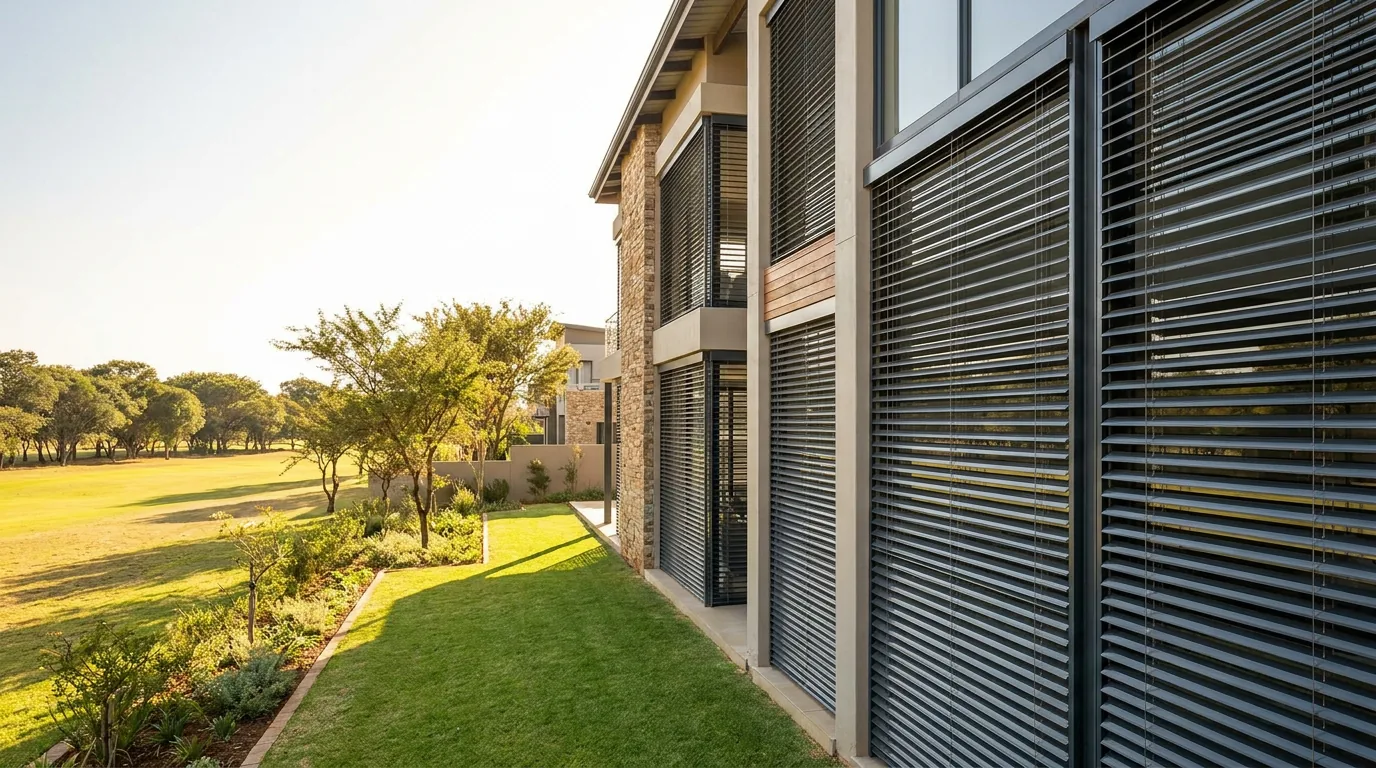
How the Pretoria East light actually behaves on a fairway-facing home here — elevation by elevation, room by room — and how we'd shade each window without giving up the view you bought the house for. No jargon, no sales pitch, honest trade-offs both ways.
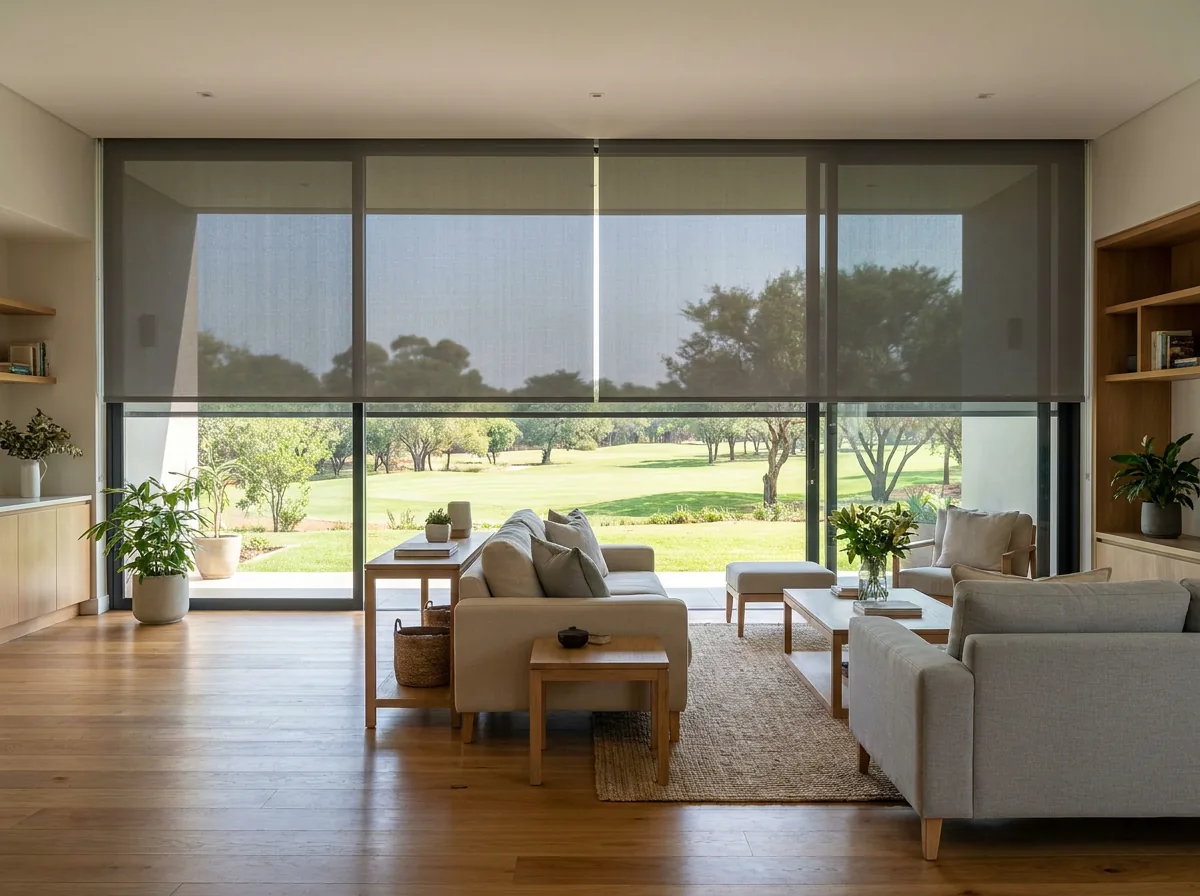
The balance most rooms here are afterA sunscreen roller lowered part-way cuts the glare and UV while the fairway stays in full view — the everyday brief on the course side of a Woodhill home.
About a 7-minute readWritten for this estate, not a templateEvery climate fact sourced at the foot
Why Woodhill is a different brief
Here the windows answer to the fairway, not the street
Most shading advice is written for an ordinary suburban street, where a house faces the road and a few mature garden trees do half the work for you. Woodhill isn't built like that. The estate grew up on a former dairy from 1999 onward, with homes routed along the contours of the golf course and positioned to look straight down a fairway or over a green — the reason most of them were bought in the first place. So the big glass follows the course, not the compass, and there is very little old canopy between it and the open turf.
That one fact quietly changes almost every decision on the property: a double-volume living wall with nothing between it and an open fairway behaves differently from the same room on a tree-lined street two suburbs over. This guide walks the light around a typical Woodhill home the way we would on a measure visit — what we'd put on each kind of window, and why we'd argue against the obvious alternative.
The light here
High sun, high UV, and a storm season to plan around
Woodhill sits on the Highveld edge of Pretoria East, at roughly 1,340 metres above sea level. Three things about that setting decide what belongs on your windows.
First, the direction of the sun. In the Southern Hemisphere the sun crosses the sky to the north, so north-facing glass takes steady sun for most of the day — right through winter, when you actually want the warmth. West-facing glass takes the hard, low afternoon sun that drives heat and glare into a room just as you sit down in it. East gets a gentler morning version that then moves off, and south-facing rooms sit in soft, indirect light all day. Because Woodhill homes are turned toward the fairway, your worst elevation is not a given — it is wherever your main glass happens to point.
Second, the strength of that sun. UV intensity climbs with altitude, and the Highveld's clear, high-pressure skies push it further still — Pretoria records high-to-extreme UV readings from roughly August through April. That is what quietly fades a timber floor, a rug or a sofa on a bright elevation over a season or two, which is why a fabric's openness factor and UV block matter more here than on a shaded street. Glare is only half the story; the other half is slow, daily damage you only notice once it's done.
Third, the weather from October to March: fast-building afternoon thunderstorms with strong gusts, and — from about mid-November to February — hail, most often in the one-to-five-in-the-afternoon window. Anything fixed to the outside of the house has to survive that, which is the single biggest reason exterior shading here is motorised with a wind sensor rather than left to chance.
Elevation by elevation
Which way your glass faces changes everything
Walk the same house on four sides and you are really shading four different problems. Here is how we would think about each — then confirm on site which one your key rooms actually fall into.
N
North — the all-day elevation
The natural home for living rooms and main bedrooms, and the side that takes steady sun morning to evening, summer and winter. The job is managing glare and UV without the room going dark and dead for half the day.
Sunscreen roller for living; add a blockout layer for bedrooms.
W
West — the problem child
Low afternoon sun straight into the room; the hottest glass on the property and the sharpest glare, right at braai o'clock. The winning move stops the heat outside the glass before it ever gets in.
External venetians, an awning or roller shutters earn their keep here.
E
East — the gentle one
Bright early sun, then it moves off and the room cools down. A lower overall heat load, so interior blinds cope easily. Bedrooms are the main concern — early light lands straight on the pillow in summer.
Blockout for early-waking bedrooms; sunscreen is plenty for living.
S
South — the easy one
Soft, indirect light all day, with little heat or glare to fight. Here the job is privacy and a clean, consistent finish across the house rather than sun control.
A light sunscreen or a simple roller does the job.
Make it yours
Want this guide marked up for your own rooms?
Tell us which windows are giving you trouble and we'll email you a short version of this playbook with a note against your actual elevations — no measure booked, no obligation.
What we'd specify, and why
Four workhorses for a Woodhill home
For each one: what it is best at here, why we would choose it over the obvious alternative, and the honest catch. Tap Add to my plan on anything that fits — it carries straight into your ballpark and measure below, with nothing to retype.
Best for north & fairway-facing living rooms
Sunscreen roller blinds
A single smooth fabric that filters glare and blocks most of the UV while you still see straight through it to the course. On the elevation your home was designed around, that is the whole game — comfort without trading away the view.
Why not just blockout? A blockout roller would darken the room and hide the fairway, so you would fight it all day and lose the reason you sit there. The honest catch: sunscreen never gives full darkness or night privacy — after dark with the lights on, even a tight 3% weave shows silhouettes, so bedrooms usually pair it with a blockout layer on the same bracket.
Best for the west elevation & any glass that overheats
External venetian blinds
Aluminium slats that sit outside the glass and tilt, so you stop the afternoon sun before it enters the room and still keep a slice of view and daylight. On a hot west fairway wall this is the difference between a lounge you use and one you abandon by three in the afternoon.
Why not an interior blockout roller? An inside blind still lets the pane heat up and radiate warmth into the room — you have caught the light but kept the heat. Stopping it on the outside is simply more effective on a west elevation. The honest catch: it is an exterior, motorised, higher-investment system and it is visible on the facade, so estate guidelines apply — where heat isn't really the problem, a plain interior blind is simpler and easier on the budget.
Best for rooms that want to tune the light through the day
Day-night blinds
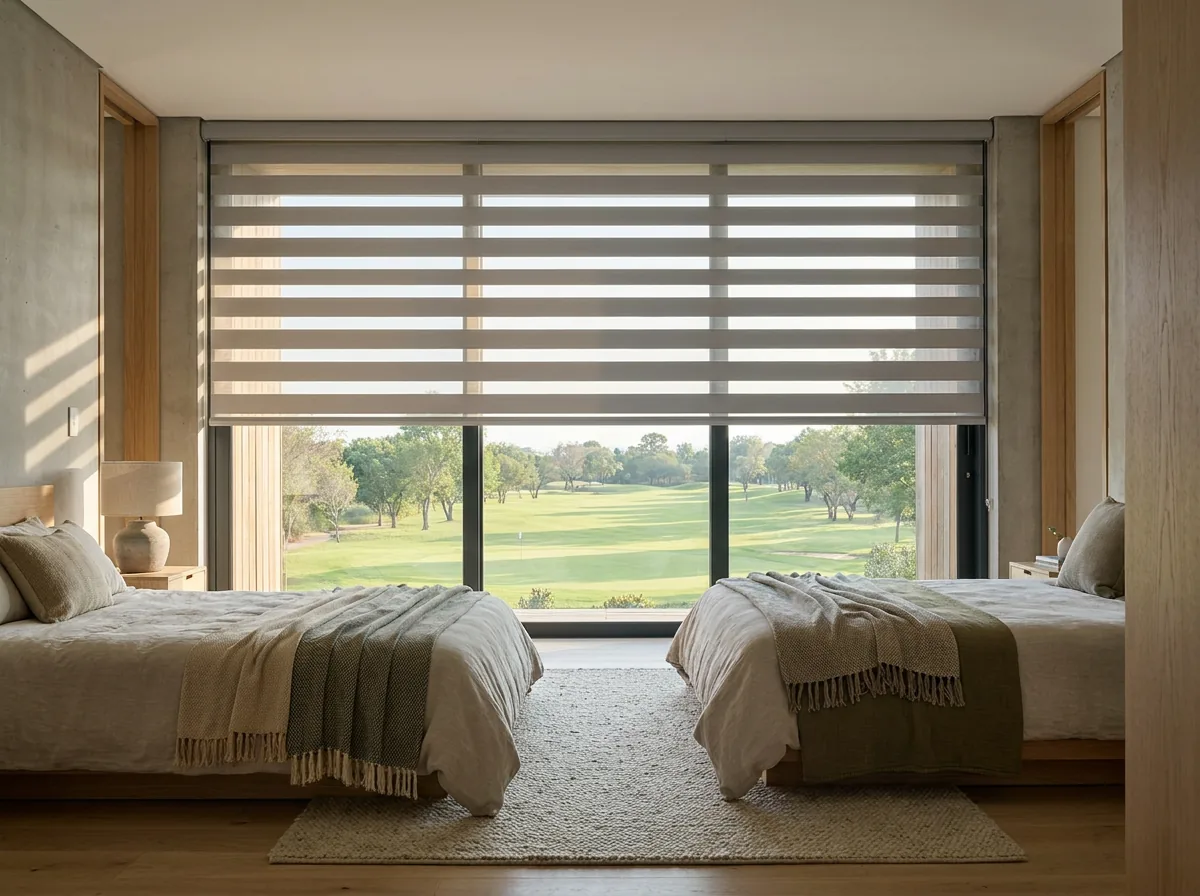
Banded sheer-and-solid fabric on a single roller: nudge the sheer bands into line for a soft, filtered view, or shift to the solid bands for privacy and glare control — all from one blind, no second product. A neat answer for a north or east room whose needs change hour to hour.
Why choose this over a plain roller? You get two modes from one blind instead of committing to fully open or fully shut. The honest catch: the solid bands aren't true blockout — a little light leaks between them — so a media room or a bedroom that needs pitch dark is still better served by a dedicated blockout roller.
Best for the entertainment patio
Folding-arm awnings
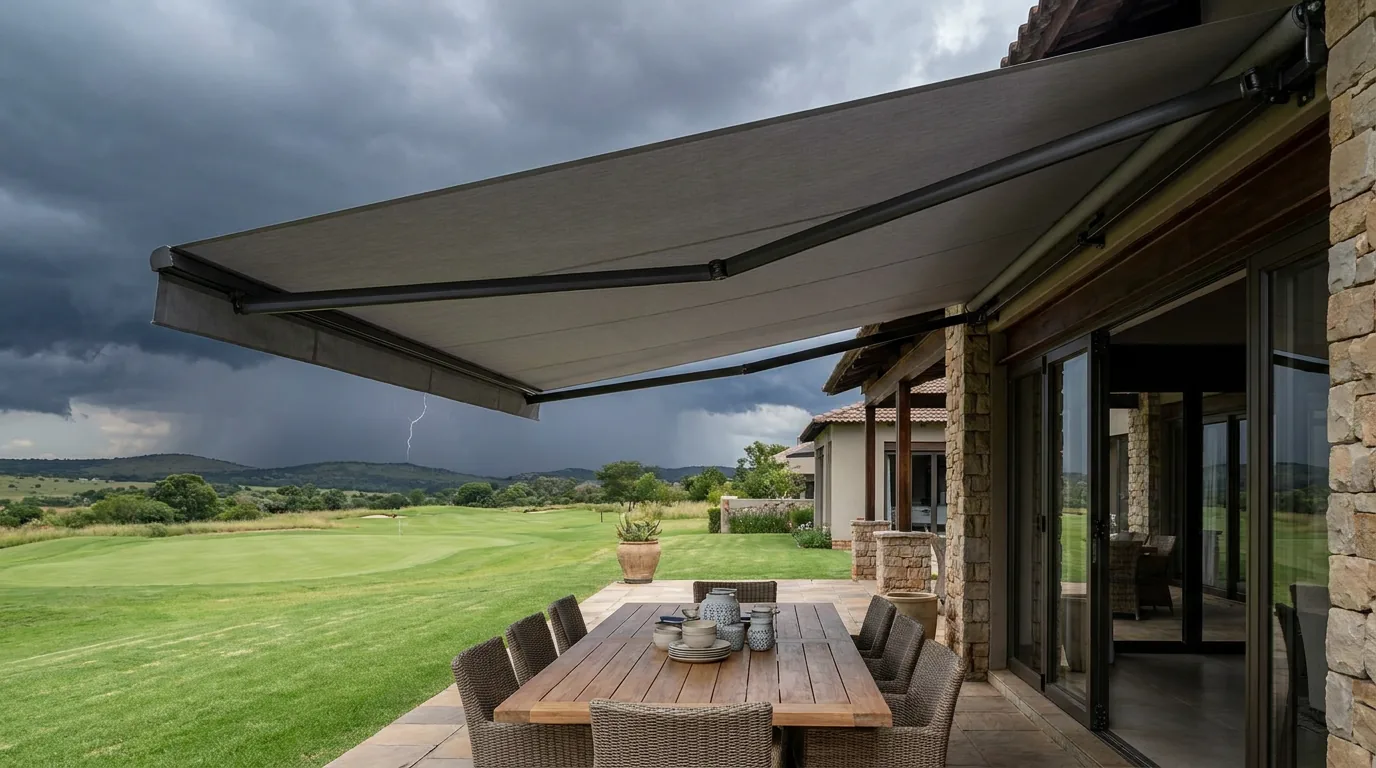
A fabric canopy that reaches out over the paving so the braai and seating stay usable through the hottest part of the afternoon, then folds away for a winter round or a clear evening under the stars. On an exposed fairway wall we fit it motorised with a wind sensor as standard, so it retracts itself before a Highveld gust or hailstorm — you don't have to be home to save it.
Why an awning and not a blind? It shades the outdoor room — the paved area you actually sit on — which a window blind can't do. The honest catch: it shades the patio, not the glass behind it; if it is the indoor room overheating, an external blind or roller shutter on the window does more than an awning ever will.
Also in the mix, depending on the room
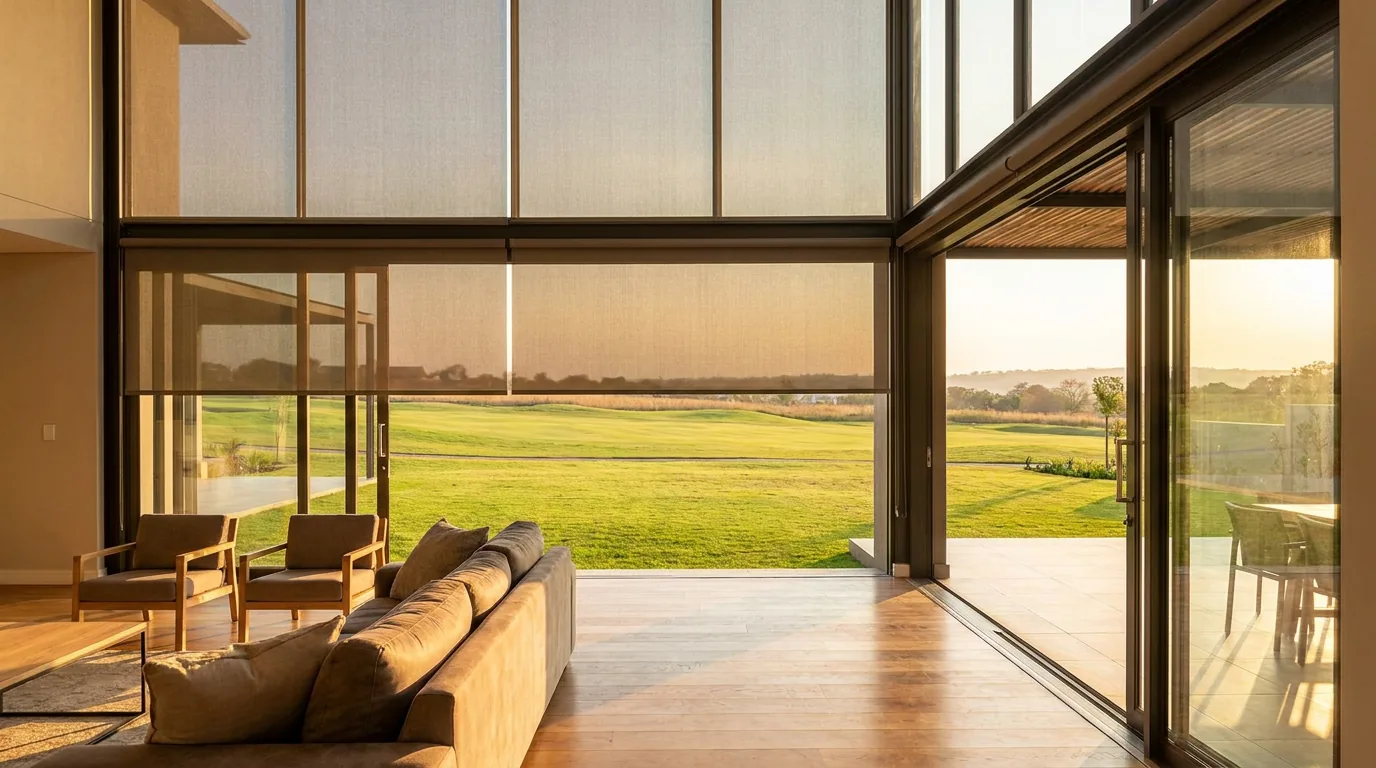
Those four cover most of the house, but a full Woodhill spec usually pulls in a few more. A blockout roller is the honest answer for any bedroom or media room that needs true dark, especially where an early tee time means the room has to stay black. Aluminium or timber venetians suit wet rooms, sculleries and studies where you want to steer each ray by hand. Cellular honeycomb blinds trap a layer of air in the blind itself, helping rooms that bake in summer and lose heat on a cold Highveld night. Zip screens close a patio off from wind and low sun without walling in the view. Roller shutters give sun, glare and full darkening in one external system — worth saying plainly that ours are shading shutters for light and heat control, not security-rated shutters, which are a separate product available on request. And motorisation ties it together on wide stacking doors and double-volume glass: sun and wind sensors do the thinking, and with no cords it is also the most child-safe option there is.
Estate & neighbourhood notes
The estate has a say — and each pocket reads differently
Golf estates like Woodhill run an architectural or aesthetic guideline covering anything visible from outside the home — including blind and awning cassette colours, exterior profiles, and sometimes whether an exterior system is allowed on a given elevation at all. We work in neutral, low-visibility colourways as standard for estate homes and supply the product documentation an owner's submission usually needs, but the final say always sits with the estate, not with us. We can't publish Woodhill's exact rules here, so we confirm them with you and the estate office at the measure, before anything is ordered. Measure and install visits are booked through the estate's access control ahead of time as a standard part of scheduling — nothing for you to arrange at the gate.
Move to a neighbouring estate and the brief shifts again. The bigger, more exposed stands of Mooikloof's equestrian estate catch more sun and wind across the day; the denser homes of The Wilds and the townhouse clusters of Six Fountains weigh privacy between close-set units as heavily as glare or heat; and the lake-facing homes of Boardwalk Meander get direct sun plus reflected glare off open water — sharper, and longer-lasting, than a purely fairway-facing room. We treat each on its own merits rather than fitting one answer everywhere.
The honest bit
What a guide can't settle — and a measure can
This playbook gets you most of the way. These five things genuinely can't be judged from a page or a photo, which is exactly why the measure is free and the quote comes after it, never before.
1
Which way your glass really faces
Homes follow the fairway, so "north-facing" on the plan and where the sun actually lands at 3 pm aren't always the same. We check the true aspect and the afternoon shadow line.
2
The reveal depth
Whether a blind fits neatly inside the window reveal or has to face-fix changes both the product and the finished look — and it is impossible to tell from across the room.
3
Existing fixings and lintels
What is behind the plaster decides how — and whether — an external system can be anchored safely on an exposed double-volume fairway wall.
4
Wind exposure on that elevation
A corner fairway wall catches gusts a sheltered courtyard never sees. That sets whether a wind sensor is essential and how an awning needs to be braced.
5
Motor power routing
For anything motorised, where the power comes from — and whether battery or wired 220 V makes sense — is a decision made at the wall, not from a catalogue.
Two ways forward
You've got the lay of the light. Here's the easy next step.
Most people book the free measure — a consultant comes to you, so nothing is guessed. If you'd rather sanity-check the budget first, pop in rough sizes for a ballpark. Either path carries whatever you added above, so there is nothing to retype.
The main event
Book your free in-home measure
A consultant visits with samples, measures every window precisely, checks the five things above, books estate access ahead of time, and leaves you with a written, per-window quote. No charge, and no pressure to decide on the spot.
Optional · about two minutes
Your ballpark, window by window
Want a budget range before you book? Pop in rough sizes for the windows you have in mind and we'll send a ballpark by the next working day. Not sure how to measure? Leave it blank — our consultant measures for free and you'll get exact per-window pricing either way.
No windows added yet — add a row, or just book the free measure.
How the ballpark reaches us: when you send the measure form, whatever you've listed here rides along as plain text — window count, rooms and all. No uploads, no third-party forms. If we need a photo, a real person asks for it in the reply.
Not ready to book?
Take the field guide with you
Leave your rooms and we'll email you this guide tailored to your elevations, so it is there when you are. No measure booked, and no follow-up unless you ask for one.
Sources
Where the climate & geography facts come from
We would rather show our working than ask you to take it on faith. The estate detail is our own on-the-ground knowledge of Woodhill; the climate and sun-path facts are drawn from these public sources.