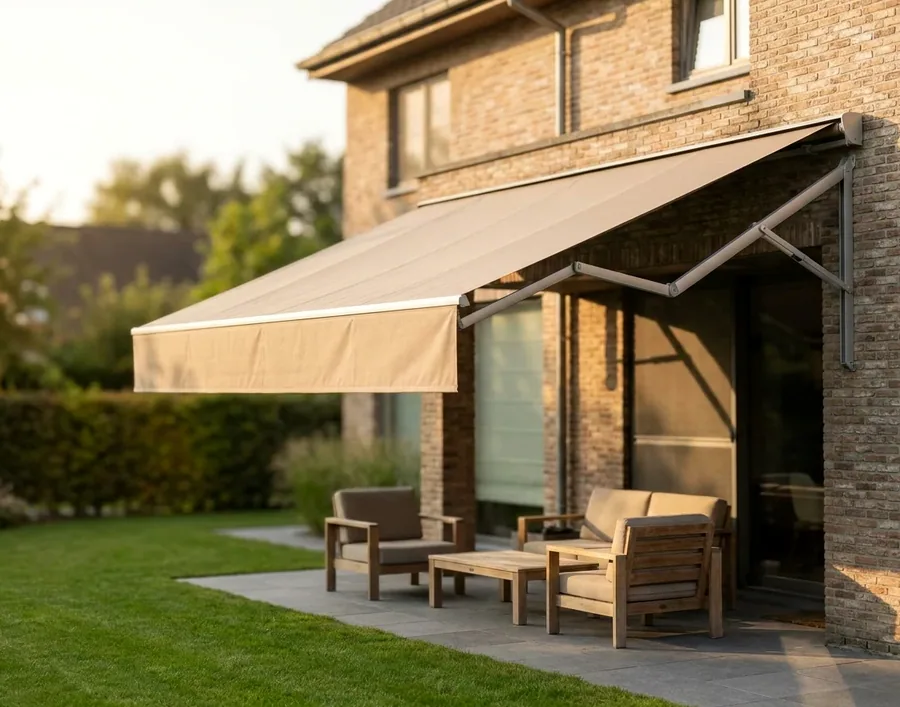
A folding-arm awning turns a baking north- or west-facing patio back into a usable room through summer, and retracts to let welcome winter sun through — a seasonal argument a fixed roof simply can't make. On a golf-estate entertaining deck, that flexibility matters: braai area, patio table and pool deck all want shade on a hot afternoon and open sky on a cool evening.
Why no posts matters here
The arms fold out from a wall- or fascia-mounted cassette with nothing touching the ground — no interrupted views down the fairway, no obstacle in the braai space, no post to work around when the outdoor furniture gets rearranged. Projection runs to roughly 3–4m over wide spans, and solution-dyed acrylic fabrics hold their colour under South African UV.
Mounting & control
Full cassette protects the fabric and arms completely when retracted — the right call for anything weather-exposed. Semi-cassette and open mounting are lower-cost alternatives on more sheltered patios. Crank handle operation exists, but motorised with a wind sensor is the responsible specification: an awning caught open in a fast-building highveld thunderstorm gust can be destroyed in seconds, and auto-retract protects the investment without you having to be home to press a button. See motorised blinds & automation for how the sensor layer works.
Honest limitations
An awning is a shade product, not a rain product — it copes with light drizzle at a working pitch, never a proper highveld downpour or standing water. Wind ratings are real engineering limits, not suggestions, and the fixing substrate (brick, timber fascia or steel) matters enough that we assess it on site rather than quote it blind.
What an awning costs over an estate patio
Pricing goes on projection: the square metres of ground the fabric actually covers once it is wound out, fitted. Hand-wound, the guide is R3,500 to R5,500 per square metre — the lower figure for an open or semi-cassette mount out of the weather, the higher for a full cassette facing it. With a motor and wind sensor on it, the range becomes R5,500 – R7,500 per square metre.
Where a patio looks down open fairway with nothing upwind, the motor and the sensor buy more than another half-metre of fabric, because an awning that folds itself away before a storm is the one still there next season. A short awning above a door carries the minimum, and the material the brackets anchor into moves changes the number as well. All of that gets decided at the free assessment on site, and the price in the written quote is the one you can hold us to.