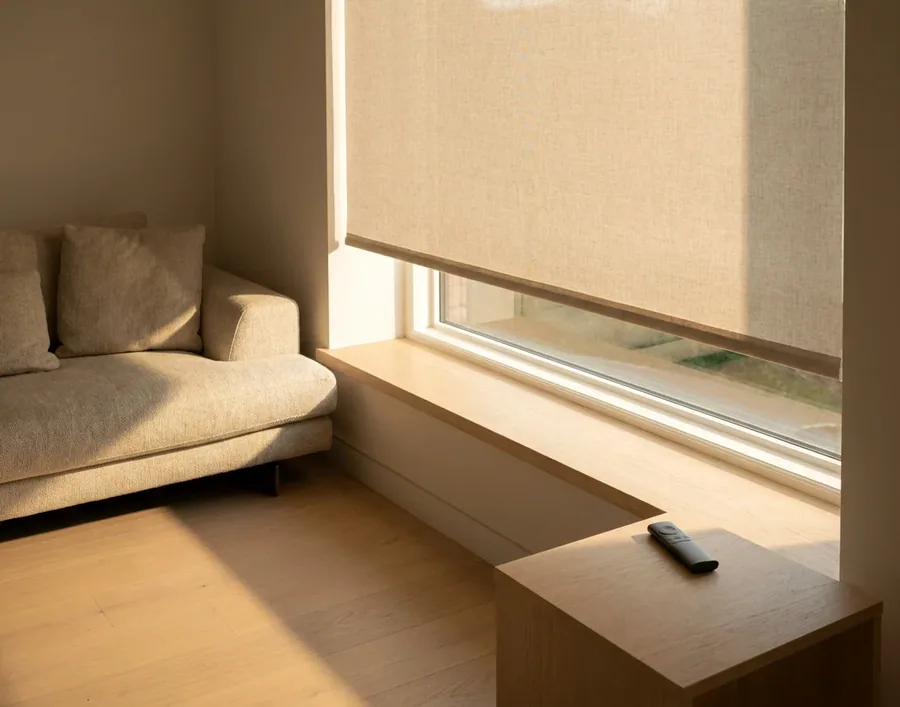
Tubular motors sit inside the blind roll itself, controlled by remote, wall switch, phone app, voice assistant, timer or sensor. On a standard reachable window it's a comfort upgrade. On the double-volume glazing and multi-blind walls common in Woodhill, it's the difference between blinds that actually get used every day and blinds that get left in one position and forgotten.
Power options
Rechargeable battery motors need no wiring and suit retrofits well — charge every few months via a USB-style charger. Wired 220V motors suit new builds and renovations: permanent, no charging, and the right choice for big or heavy systems and exterior products, with an electrician planning the run at design stage. Solar trickle options exist for awkward, hard-to-reach positions such as high clerestory glass.
How Woodhill homes actually use it
- Handset remote — one remote, every blind in a room or a whole wing.
- App control — drop the west-facing blinds from the golf cart, or check you didn't leave them up before a trip.
- Schedules — bedroom blinds open with sunrise; fairway-facing living blinds drop automatically in the hardest part of the afternoon.
- Sun sensors drop shading on the hot elevations without anyone touching a switch.
- Wind sensors retract exterior products — awnings, zip screens, external venetians — before a highveld storm gets to them. This is safety-critical on anything mounted outside.
When motorisation is essentially required
Spans too wide or heavy for a chain, blinds above stair voids or double-volume glass, concealed ceiling-recess systems, and every exterior product — external venetians, awnings, zip screens — are cases where motorisation isn't an upsell, it's the working solution. Multi-blind walls of glass reduce to "one button, six blinds."
Safety, honestly
No dangling chains makes motorisation the safest operation type there is for a home with small children — the gold standard, not just an alternative. Quality motors are quiet but not silent, and carry multi-year guarantees; battery motors need that periodic charge, which we'll set clear expectations on at the quote stage.
What automation adds to the figure
Motorisation is never priced on its own, because the motor always belongs to a product. Across the automated range the installed figure runs from R2,500 at one end to R7,500 at the other, per square metre. Lowest of all is an interior roller with the motor inside the tube band; an estate-friendly exterior system built to live outdoors is at the top.
Sun sensors, wind sensors, keypads and hubs are quoted on their own lines rather than folded into a square-metre rate, so you can weigh each window on its own merits. Small openings carry a minimum charge. Every number here is orientation only — the binding figure comes after the measure, when the motor count, the products they sit in and the power supply for each are all settled.