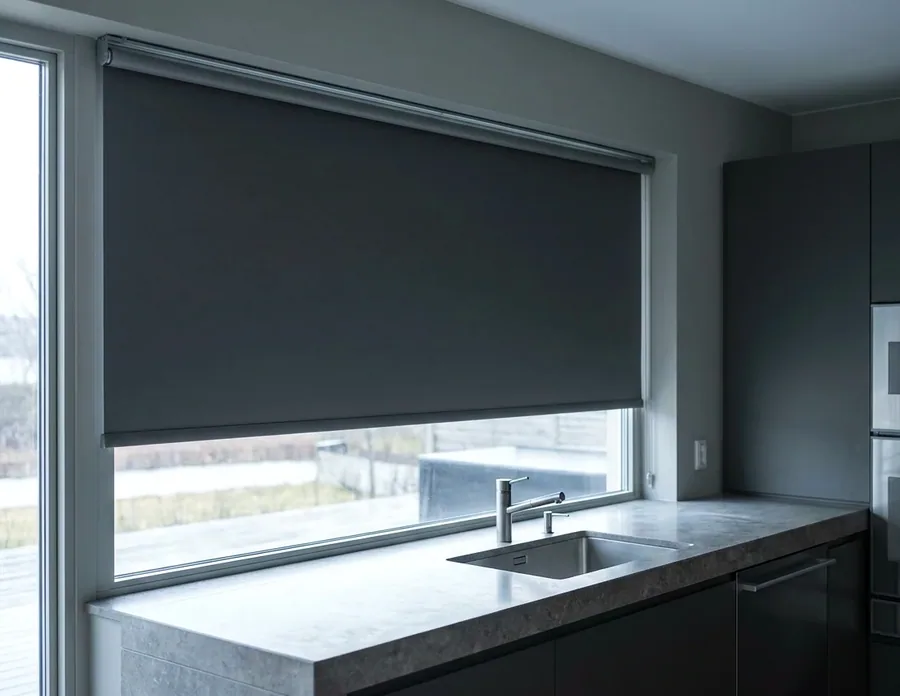
Roller blinds do more of the work than any other product in a Woodhill home, and for good reason — they suit the big aluminium glazing this estate is built around, they're the fastest to specify, and the fabric range covers almost every brief on the fairway side of the house.
Choosing the fabric
Blockout gives a total light stop and a useful thermal buffer against both the summer heat and winter cold — the right call for bedrooms, especially where an early tee time means the room needs to stay properly dark. Sunscreen mesh, usually specified at 3–5% openness for view-preserving rooms, cuts glare and UV off fairway-facing glass while keeping the green visible from the couch — this is the fabric most Woodhill living rooms end up with. Light-filtering fabric softens daylight and adds privacy without blocking the view entirely, a good middle ground for a study or passage.
The double roller
Blockout and sunscreen fitted on one bracket is the practical answer for a bedroom that still wants the fairway view by day — sunscreen down for the afternoon glare, blockout down for the night. It's one of the most requested combinations on this estate.
Wide glass, real answers
Woodhill's stacking doors and open-plan living walls often run wider than a single blind can comfortably span — a standard roller tops out near 3m of fabric width. Beyond that we either split the run with a central join line or link blinds on a motorised system so a whole wall of glass moves together. Chain control comes with a child-safe tensioner as standard; for higher or wider runs, motorisation (see our motorised blinds & automation page) is usually the better answer.
Finish details
Cassette or pelmet valances hide the tube for a cleaner line, with the fascia colour-matched to your window frames. Inside or outside mount is decided at the measure, depending on your recess depth and how much of the frame you want covered.
What a roller blind costs on the estate
A guide per square metre, installed, rather than a quotation. A roller worked by hand, in any of those cloths, is R1,000 to R1,600 per square metre of glass covered. Stock-colour blockout is the cheap corner of that band; a 3% sunscreen in a wide fabric, or a doubled bracket holding both fabrics at once, sits high in it.
Motorised, it lands between R2,500 and R3,800 the square metre, covering motor, control gear and the commissioning done on site. Across a stacking-door wall that is the practical answer rather than a luxury. Small windows carry a minimum charge, since the brackets, tube and installer time barely change with size, and the figure that binds is written per opening after the free measure.